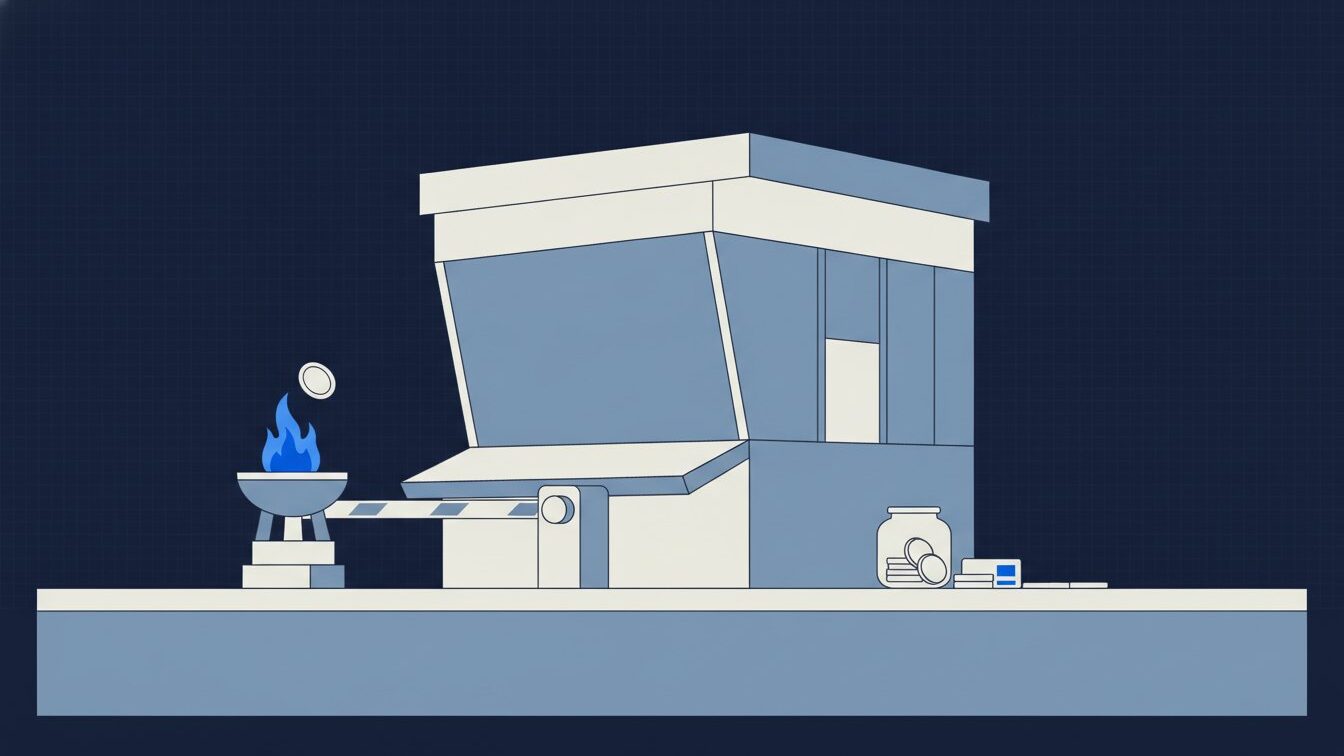
Since EIP-1559, every Ethereum transaction fee is made of two separate pieces that behave completely differently: a base fee that the protocol sets and destroys, and a priority fee (tip) that you choose and that goes to whoever proposes the block. Understanding why those two pieces exist separately explains most of what looks confusing about Ethereum gas pricing.
The base fee: a protocol-set price, not a bid
Each block has a gas limit, and a target equal to half that limit — the “elasticity multiplier” of 2 means blocks can flex up to double their target before hitting the hard ceiling. The base fee for the next block adjusts automatically based on how full the previous block was relative to that target:
- A block exactly at target leaves the base fee unchanged.
- A block above target raises the base fee, by up to roughly 12.5% if the block was completely full (double the target).
- A block below target lowers the base fee, by up to roughly 12.5% if the block was empty.
That 12.5% figure comes from a fixed adjustment denominator of 8 in the protocol’s own formula, and it caps how much the base fee can move in a single block in either direction — which is why gas prices rise and fall gradually across a sequence of blocks during sustained demand, rather than jumping instantly to whatever level would clear the market in one step.
The base fee is not paid to anyone. It is burned — destroyed by the protocol — which was one of EIP-1559’s deliberate design goals: removing a source of revenue that block producers could otherwise manipulate by artificially constricting block space to drive fees up.
The priority fee: your actual bid
On top of the base fee, a transaction includes a max_priority_fee_per_gas — the most you’re willing to tip the block proposer per unit of gas — and a max_fee_per_gas, the absolute most you’ll pay per unit of gas covering both the base fee and the tip combined. The actual tip paid is whichever is smaller: your specified priority fee, or the gap between your max fee and the current base fee. If the base fee rises close to your max fee, your effective tip shrinks automatically rather than your transaction simply failing, as long as your max fee still clears the current base fee at all.
A transaction is invalid outright if its max fee is below the current base fee, or if its max fee is below its own specified priority fee — the protocol will not let you submit a transaction promising a tip larger than the total you’re willing to pay.
Why this replaced first-price auctions
Before EIP-1559, every transaction simply named a single gas price, and all transactions competed in what was effectively a blind first-price auction — everyone had to guess what everyone else was bidding, which led to systematic overpayment during busy periods as users padded their bids defensively. Splitting the fee into a predictable, protocol-computed base fee and a much smaller, optional tip removes most of that guesswork: the base fee tells you what the network is currently charging as a baseline, and the tip only needs to reflect how much you specifically want to jump the queue during real congestion, not what the entire market might be bidding blind.
What this looks like in practice
During quiet periods, blocks run under target, the base fee drifts down, and a minimal or even zero tip is often enough to get included in the next block or two. During a demand spike — a popular mint, a volatile market move driving liquidations and arbitrage, a widely used protocol under load — blocks run at or near the ceiling, the base fee climbs block by block, and tips rise as users compete to be included sooner rather than wait for the base fee’s gradual climb to ration access on its own. Because the base fee’s rate of change is capped per block, a sudden demand spike takes several blocks to reach its new equilibrium level rather than jumping there instantly, which is part of why fees can keep rising for a few minutes even after the triggering event has already happened.
Blob fees, covered in the companion guide on blob fees and data availability, work on a structurally similar burn-and-adjust principle but are priced in a completely separate market from the regular gas described here — a transaction’s total cost on an L2 can be moving for reasons that have nothing to do with the base fee mechanics on this page.
Reading a live gas price correctly
A quoted “gas price” in gwei is really the sum of the current base fee plus whatever tip a given tool assumes; it is a live number that can shift within the time it takes to read it, not a fixed cost of using Ethereum. For a current reading, use a live source rather than any number quoted in an article, including this one.
Intrinsic cost: why a simple transfer is cheap
Every transaction carries a fixed intrinsic gas cost of 21,000 units before any computation or data even runs, plus a per-byte charge for any data it carries — 16 gas for each non-zero calldata byte, 4 gas for each zero byte. A plain ETH transfer with no extra data is close to this floor, which is why it is reliably one of the cheapest things you can do on Ethereum relative to a complex contract interaction that reads and writes many storage slots.
The gas limit can also move, slowly
The block gas limit itself — the ceiling the target is half of — is not permanently fixed either. Block proposers can nudge it up or down by a small amount each block, bounded to less than one part in 1024 of the parent block’s limit, with a protocol-enforced floor of 5,000 gas. This is a separate, much slower-moving lever from the base fee itself, and changes to it show up as a shift in how much total activity a single block can hold, not in the per-unit price of gas directly.
None of these mechanics mean gas is cheap in any absolute sense — only that its price follows a predictable, bounded adjustment process rather than an unbounded auction. Knowing the rule does not change what a given moment on the network actually costs.
If you are trying to understand a wallet’s fee estimate, the clearest mental model is: base fee is what the network is charging everyone right now, and the tip is the extra you are personally offering to jump ahead of other transactions competing for the same block space.
Risk note
Gas prices move with network demand in ways that are often outside any individual user’s control. Setting a max fee far below current conditions risks a transaction sitting unconfirmed indefinitely; setting one far above does not speed inclusion once the network is no longer congested. Neither choice is a trading decision — it is purely a matter of transaction mechanics.
Not financial advice. Nothing on this page is a recommendation to buy, sell, stake, bridge, or avoid any asset or protocol.
FAQ
Why did my transaction fee change between when I signed it and when it confirmed?
The base fee is recalculated every block based on how full the previous block was. If you set a max fee with enough headroom, the protocol only charges the current base fee plus your effective tip, which can be lower than your specified maximum.
Is the base fee paid to validators?
No. The base fee is burned — destroyed by the protocol — specifically so block producers cannot profit by manipulating it. Validators are paid only through the priority fee (tip) and the separate protocol block reward.
Why does gas stay expensive for a few minutes after a demand spike ends?
The base fee can only move by roughly 12.5% per block in either direction, so it takes several blocks to climb to a new equilibrium during a spike and several more to ease back down afterward.
Does this guide tell me what gas costs right now?
No. Gas conditions change block by block. Use the site’s live gas page for a current reading rather than any number in this article.
Frequently asked questions
Why did my transaction fee change between when I signed it and when it confirmed?
Is the base fee paid to validators?
Why does gas stay expensive for a few minutes after a demand spike ends?
Does this guide tell me what gas costs right now?
Educational content, human-edited and possibly AI-assisted. It describes how systems work and is not financial, legal or tax advice. Report an error via our corrections page.